
Melvor Idle 2 Beginner Tips: 12 Habits for Week One
Twelve Melvor Idle 2 beginner tips for launch week: quest order, food chains, bank space, combat style and the mistakes that cost a week.
Most beginner advice for idle games is a variation of "be patient". That is not useful when a quest boss is blocking the story and your food stack is empty. These twelve habits are about sequencing: what to do first, what to leave running, and what not to spend.
They assume the 17 November Early Access build: level cap 99, 29 skills, quests and Act 2. If a patch changes a number, the habit usually survives even when the number does not.
The first-week checklist
| Habit | Do it in the first hour | Why it pays |
|---|---|---|
| 1. Follow the quest chain | Yes | Quest rewards and unlocks are cheaper than grinding the same levels |
| 2. Pick one combat style | Yes | A focused style clears the first bosses; a split style does not |
| 3. Build a food chain | Yes | Fishing plus Cooking is a renewable death-insurance policy |
| 4. Keep two bank tabs free | Yes | Bank space becomes a real constraint by the second week |
| 5. Start Farming early | Day one | Plots run on real time; starting late delays every potion |
| 6. Read the Codex first | Every new item | It tells you source and use without leaving the game |
| 7. Train long actions offline | Every session | Offline runs at the same rate, so short actions waste the window |
| 8. Use Slayer as a tour | After first combat style | Tasks expose monsters and pay points for unlocks |
| 9. Upgrade the weapon first | First gear decision | Damage ends fights; armour only extends them |
| 10. Keep five of each material | Ongoing | Ten is hoarding, one is a shortage when a quest asks |
| 11. Do not chase 99 in week one | Ongoing | Early Access balance will move; breadth beats a trophy |
| 12. Note the patch number | Every session | Advice without a patch number is a rumour |
Habits 1–4: stop the early stalls
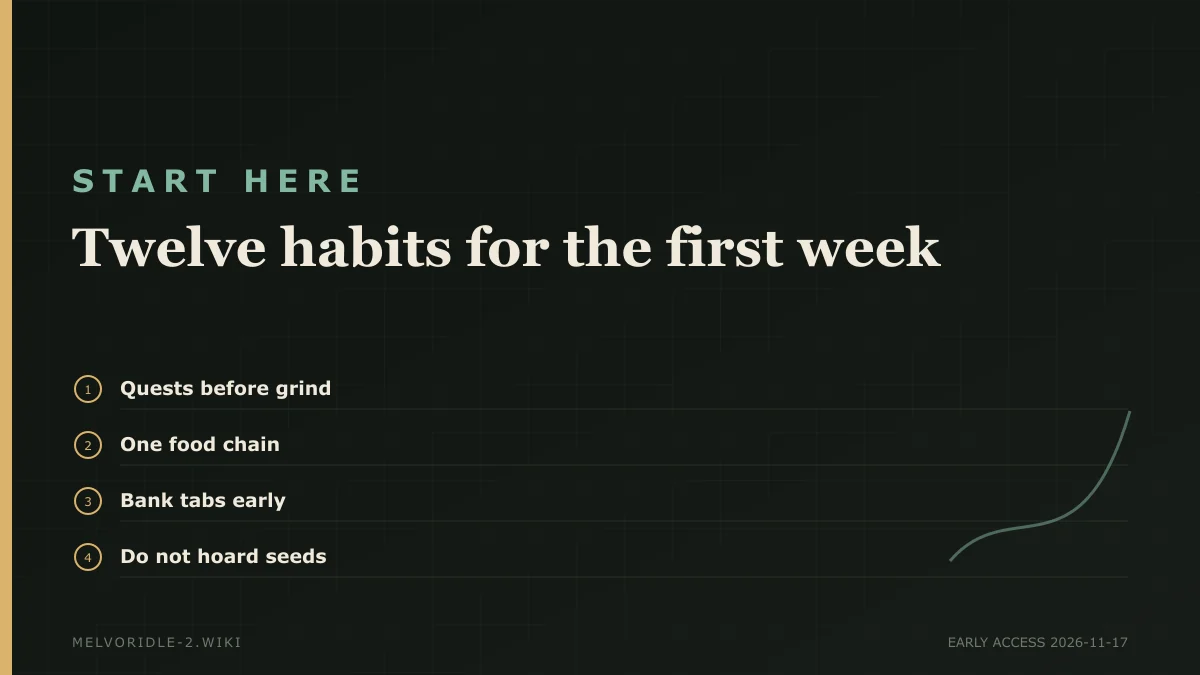
Quests before grind. The sequel uses quests and quest bosses to gate story progress. A quest that asks for a level 20 skill is a signal, not an obstacle: train the skill, claim the reward, move on. Grinding past a quest usually means grinding the same content twice.
One combat style. Attack, Strength, Defence, Ranged and Magic all compete for the same food budget. Pick the style your first good weapon supports, push it until the quest bosses die, then branch. The combat leveling page→ explains the breakpoints.
A food chain, not a food stack. Buy food once and you will run out at the worst moment. Fishing and Cooking gives you a replaceable stack, and the leftover fish sell. Even a modest Cooking level turns a bad dungeon run into a recoverable one.
Bank tabs are content. The sequel expands bank and equipment management with placeholders, shortcuts, tabs and set naming. Use them. Two free tabs at all times is the difference between a clean bank and an afternoon of sorting.
Habits 5–8: use time instead of fighting it
Start Farming on day one. Farming is the only common skill that runs on real time whether you are logged in or not. Herbs feed Herblore; Herblore is the difference between a boss attempt and a boss clear. Planting late does not just delay Farming, it delays every potion you will want later.
The Codex is faster than a wiki tab. The in-game Codex covers items, mechanics, sources and uses, with mod support planned. For "where does this drop" and "what is this for", it is the first stop. Use the items guide→ for the decisions the Codex does not make, such as what to keep.
Offline time is a resource. Offline progress runs at the same rate as online. That makes long actions the correct default before you close the game: a ten-minute action wastes eight hours of window, a two-hour action does not.
Slayer is a guided tour. Take tasks even when they are not optimal. The points buy unlocks you cannot get elsewhere, and the task list drags you through monsters that drop upgrade materials. The Slayer guide→ covers the unlock order.
Do not sell every bone, seed and herb to clear the bank. Bones feed Prayer, seeds feed Farming, herbs feed Herblore. Selling the inputs to three skills to buy one weapon is how a account stalls at the first real wall.
Habits 9–12: spend like a planner
Weapon before armour. A better weapon shortens every fight; better armour lengthens the ones you were going to win anyway. Upgrade the weapon, then the body and legs, then jewellery. The equipment guide→ has the slot order.
Five is the right hoard size. Keep roughly five of each common material. Quests and upgrades ask for small counts; hoarding fifty wastes bank slots, keeping one guarantees a gathering detour.
Breadth beats a trophy 99. Early Access caps at 99 and the full release raises it to 120. A 99 in a skill you do not use is a week of real time converted into a number. A spread of 40s with food, gear and potions clears content.
Write down the patch. Balance changes will invalidate specific advice. The habit that survives is recording which build a tip came from, so you know when to re-check it.
FAQ
Should I play the demo first? The demo is over. Early Access contains its content plus three skills, so start there.
Can I max every skill in Early Access? You can reach 99 in every skill, but the time cost is enormous and the cap rises to 120 at full release. Most players should build breadth first.
Is it worth buying bank slots early? Yes, up to the point where the next slot costs more than a gear upgrade. Bank space is a permanent quality-of-life purchase; a weapon is replaceable.
Do mods disable achievements? In the first Melvor Idle, modded saves could not earn Steam achievements. The sequel has an in-game mod manager but has not published a different policy, so assume the same until confirmed.
Official source: Melvor Idle 2 on Steam ↗ Official source: Melvor Idle 2 Early Access notes ↗ Community source: r/MelvorIdle discussion ↗