
Melvor Idle 2 Guide: Launch Routes, Skills and Combat
A complete Melvor Idle 2 guide for the 17 November 2026 Early Access launch: first skill routes, combat basics, money and what to ignore.
Melvor Idle 2 launches into Steam Early Access on 17 November 2026, and the first week will be messy in a useful way. The game keeps the original's single-player idle loop, adds quests and quest bosses, reworks every skill's mastery through guilds, and raises the full-release level cap to 120 while stopping Early Access at 99. That combination means a route built for the demo is not automatically a route built for launch.
This hub is the short version: the order to touch systems, the decisions that age well, and the pages that go deeper. Every claim here is either from the official store material, the 29 October Early Access announcement, or the public demo that ran from 19 to 26 October. Where a number comes from the first Melvor Idle rather than the sequel, the page says so.
What actually changes at launch
Early Access is the demo content plus three skills (Astrology, Herblore and Agility), four new Mastery Guild ranks, roughly 1,800 items, 150-plus monsters, about 25 pets, and Act 2 of the main story. The level cap moves from 60 in the demo to 99. Demo saves carry over, so anyone who pushed a skill to 60 keeps that head start.
The parts that matter for planning:
- Twenty-nine skills share one bank and one action slot. You are always choosing what not to train.
- Quests gate progress in a way the first game did not. Quest bosses create combat checks that a pure skilling account cannot pass.
- Mastery Guilds replace the old per-action mastery grid with ranks earned across a skill, including combat.
- The Codex tells you where an item comes from and what it is used for, which removes a lot of wiki tab-switching but not the need for a plan.
- Offline progress runs at the same rate as online, so the correct question is never "how long can I leave this running" but "what is worth leaving running".
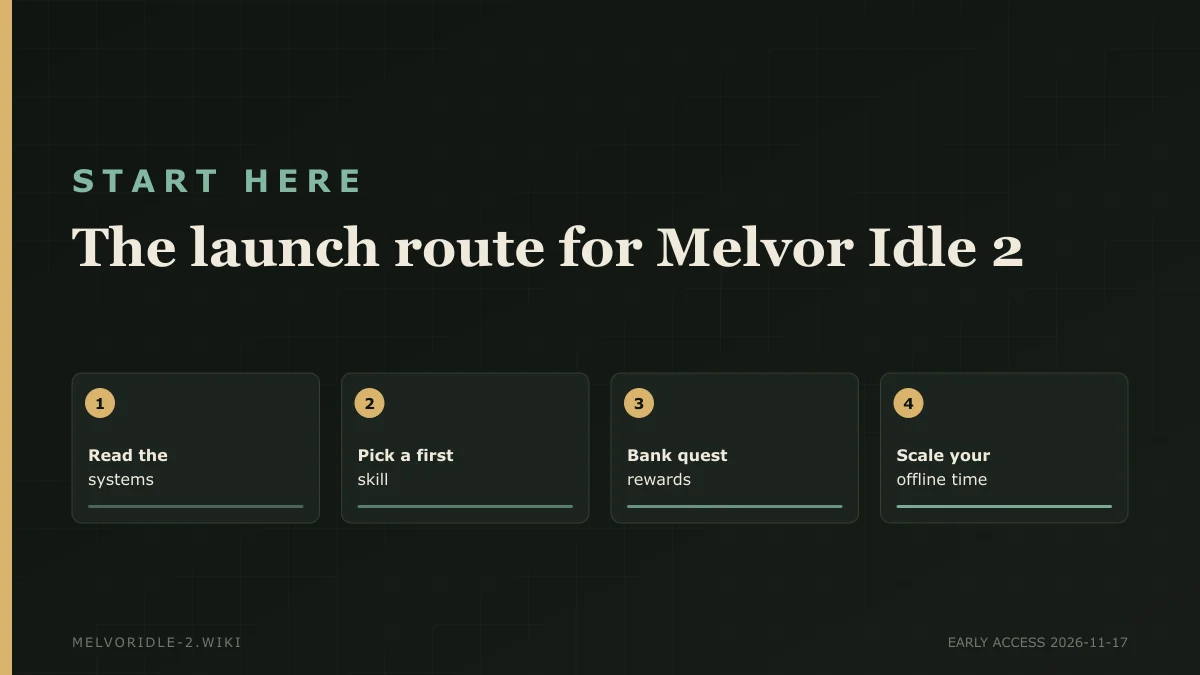
The first ten hours, in order
The launch route is built around one constraint: combat needs food, food needs a gathering skill, and gear needs a second production chain. You can ignore the order and still play, but you will spend the first week walking back to lower-tier content.
| Stage | Do this | Why it unlocks the next step |
|---|---|---|
| 1 | Finish the opening quest chain and keep one combat style levelled | Quest rewards seed the bank; combat opens Slayer and dungeons |
| 2 | Fish and cook a food stack you can replace | Death is a resource problem more than a stat problem |
| 3 | Mine and smelt bars for the first real weapon and armour | Quest bosses check damage and accuracy, not just level |
| 4 | Start Thieving for cash and unique drops | Money buys bank slots, seeds and potions without idling a money skill |
| 5 | Add Farming and Herblore before the first hard wall | Potions are the cheapest way to turn a failed boss into a clear |
That is deliberately not "max one skill first". A single 99 in Early Access is a trophy; a spread of 40s with food, gear and potions is a working account. The detailed version lives in the skill order guide→, and the money side is in money making→.
Early Access balance will move. Do not spend the first week chasing a 99 in a skill whose output you are not using. Levels are permanent, but the time is not refundable.
Combat is now a planning problem
The sequel keeps the combat triangle but adds stances, accuracy ratings and evasion ratings that are visible before a fight. That sounds like more homework; in practice it means you can diagnose a loss. If your chance to hit is low, the answer is accuracy or a different stance, not another ten levels. If you are hitting but dying, the answer is food, prayers or armour.
Three habits carry the whole combat game:
- Pick one style for the first twenty levels. Splitting attack, strength, defence, ranged and magic early produces a character that is mediocre at every wall.
- Read the encounter before the dungeon. A dungeon is a chain of fights with one food budget; the first room tells you whether the run is viable.
- Use Slayer as a guided tour. Tasks force you to fight things you would skip and pay points for unlocks that matter later.
The combat guide→ covers stances and accuracy. The equipment guide→ covers upgrade order, and the dungeons guide→ covers the first walls.
What to ignore until later
- Tier lists made during the demo. A tier list is only as good as the patch it was written on. The current tier list→ explains the criteria so you can re-rank after a balance pass.
- Mods. The game ships with an in-game mod manager, but mods can change achievements and are not the right first run.
- Mobile. Steam Early Access comes first; iOS and Android follow. Do not plan a commute account yet.
- Completionism. The full release raises the cap to 120 and adds content. Chasing 100 percent during Early Access is a recipe for burnout.
FAQ
Is Melvor Idle 2 a sequel or a remake? It is a new game with a new engine (Godot and C#), a new quest structure and reworked skills. It is not a save-compatible continuation of the first Melvor Idle.
Do demo saves carry into Early Access? Yes. The demo ran at a level 60 cap and Act 1; those saves continue into the 17 November build.
How long is Early Access? The developer's estimate is 12 to 18 months to finish the full content set, with the level cap rising to 120 at full release.
Do I need the first game to understand this one? No. The systems overlap, but the quests and Codex teach the sequel on its own terms. The comparison page→ lists what carries over mentally and what does not.
Official source: Melvor Idle 2 on Steam ↗ Official source: Melvor Idle 2 Early Access announcement ↗ Community source: r/MelvorIdle ↗