
Melvor Idle 2 Skill Order: The Route Without Dead Ends
The Melvor Idle 2 skill order for Early Access: what to train first, which chains feed combat, and when to stop grinding a skill.
The correct skill order in Melvor Idle 2 is the order that removes the next bottleneck. That sounds obvious until you watch a account with 70 Woodcutting and no food die to a quest boss. Levels are permanent, but the time you spent on them is not, and the sequel's quest gates punish a one-skill plan harder than the first game did.
The route below assumes a fresh Early Access account at level 99 cap. It is built for breadth first, depth second, and it treats combat as a skill chain rather than a separate game.
The four phases
| Phase | Target | Skills | Stop when |
|---|---|---|---|
| 1. Survive | First 10 hours | Quest chain, one combat style, Fishing, Cooking | You can replace food faster than you eat it |
| 2. Gear | Hours 10–30 | Mining, Smithing, Thieving | Quest bosses die without a second attempt |
| 3. Sustain | Hours 30–60 | Farming, Herblore, Prayer, Slayer | You have potions, prayer points and a task loop |
| 4. Scale | Hours 60–99 | Agility, Astrology, best money skill, dungeons | The next upgrade costs more than a day of idle time |
The phases are not strict. A quest can pull you into phase 3 early, and a good drop can skip phase 2. The rule is that you never leave phase 1 without a food chain, and you never enter phase 4 without potions.
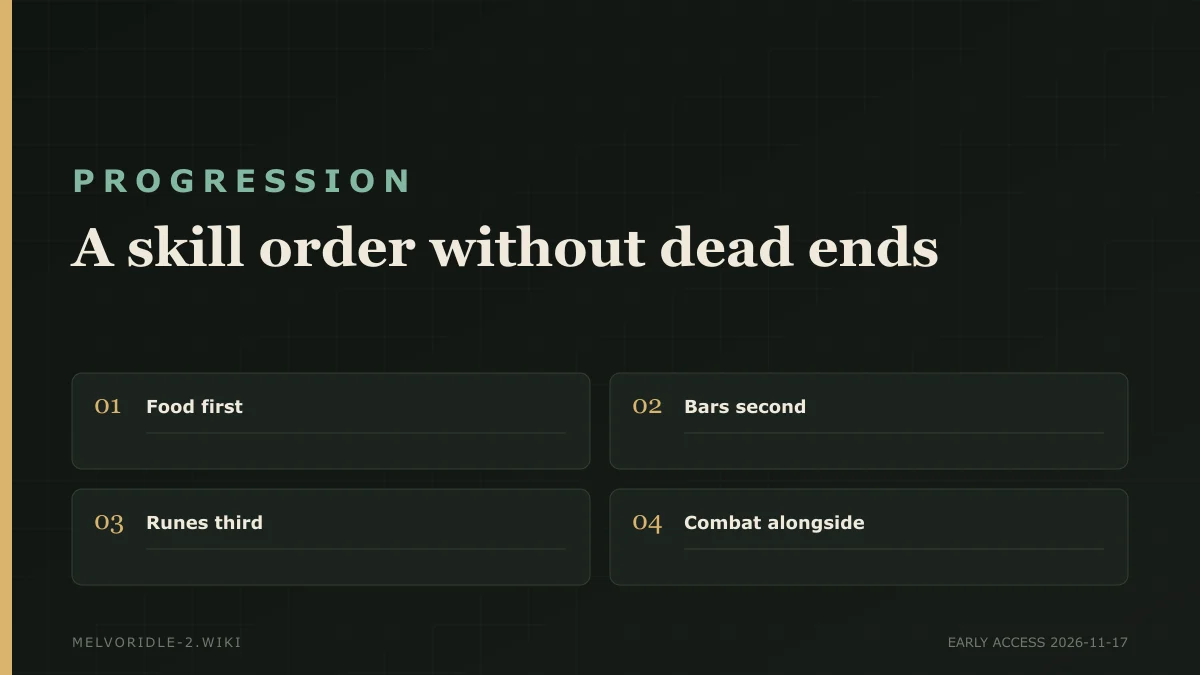
Why food comes before bars
Combat is the gate for quests, Slayer and dungeons. Combat consumes food. Therefore the first production chain that matters is the one that replaces food, not the one that makes a slightly better sword.
Fishing plus Cooking is the cheapest version of that chain. Fish are also sellable, so the same action produces combat insurance and cash. Mining and Smithing come second because gear is a multiplier on a working food budget, not a replacement for it.
The demo data supports the breadth argument. Players reported roughly 10 to 12 hours to push a single skill to the level 60 demo cap under good conditions. Early Access goes to 99. If one skill to 60 is most of a week, then five skills to 40 is a far better launch account than one skill to 99.
Why Thieving is in the gear phase
Thieving solves two problems at once: it produces cash without selling your skilling outputs, and it drops seeds and unique items that feed Farming and Herblore. Cash buys bank slots, which are a permanent upgrade, and bank slots are what let you keep the inputs for three skills at the same time.
Do not over-invest early. Get Thieving to the point where a session funds the next bank slot and a stack of seeds, then leave it. The money making guide→ covers the transition points.
When to stop training a skill
Use three stop rules:
- Stop when the output is not consumed. If you are not using the bars, logs or fish, the level is a number. Switch to the skill that consumes them.
- Stop when the next level costs more than the upgrade it unlocks. Early levels are cheap; the 80s are not. If the next milestone is cosmetic, bank the time.
- Stop when a quest asks for something else. Quest rewards are usually cheaper than grinding the same level twice.
A 99 in a gathering skill looks efficient because the XP bar moves. It is not efficient if the account still has no food, no gear and no potions. Early Access is a breadth game.
Where combat fits
Combat is not phase 1 or phase 2; it runs alongside both. Pick one style, train it on the monsters the quest chain puts in front of you, and use Slayer tasks to fill the gaps. The combat guide→ explains stances and accuracy; the combat leveling page→ covers the efficient grind.
Once the first quest bosses are down, add dungeons. Dungeons are the best test of whether your food, gear and potions are actually working, because a failed run costs the whole budget rather than one fight.
FAQ
Should I rush 99 in one skill? No, unless the skill directly funds your next goal. The full release raises the cap to 120, so a 99 now is not the final ceiling.
Can I skip Farming? You can skip the plots, but you cannot skip Herblore without making every combat wall harder. Farming is the cheapest herb supply.
Is Woodcutting worth training early? It is a good AFK skill and a source of cash, but it does not feed combat directly. Train it when you need logs for Firemaking or Fletching, not as a first priority.
How many skills should I level at once? Two or three. One combat style, one gathering skill and one production skill is enough to keep the account moving without spreading too thin.
Official source: Melvor Idle 2 on Steam ↗ Official source: Early Access content announcement ↗ Community source: Melvor Idle wiki skill guides ↗